Albeit defined as a retrospective tracing Mohamed Bourouissa’s career, Signal, curated by Hugo Vitrani at the Palais de Tokyo, is more akin to a garden of forking paths. A dual citizen, born in Algeria and raised in France, Bourouissa’s work focuses on themes relating to the imprisonment of both the body and mind, policing, resilience, care, heritage and healing. Conceived as a musical score, an album of some sorts, the show’s sinuous scenography dialogues with the museum’s architecture resulting in engulfing the viewer in a breathing ecosystem populated by screens, speakers, plants, immersive rooms, wooden and metal structures as well as sculptures, watercolors and photographs.
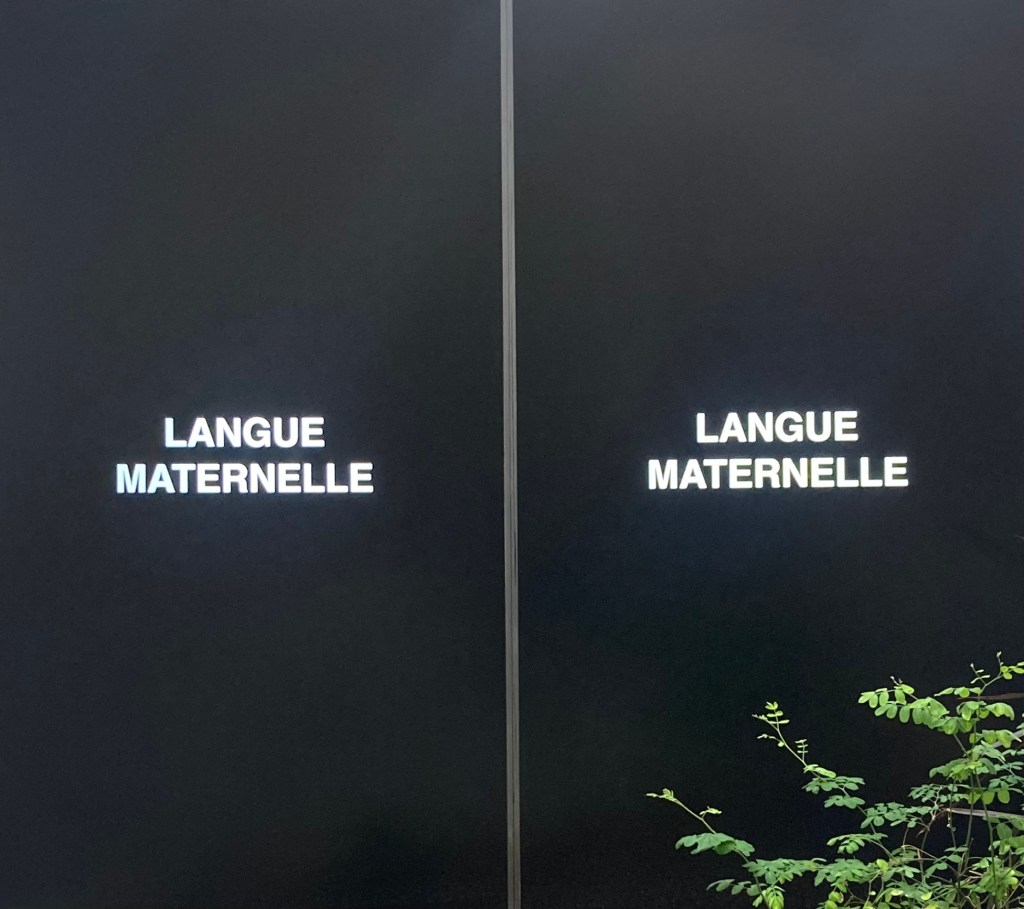
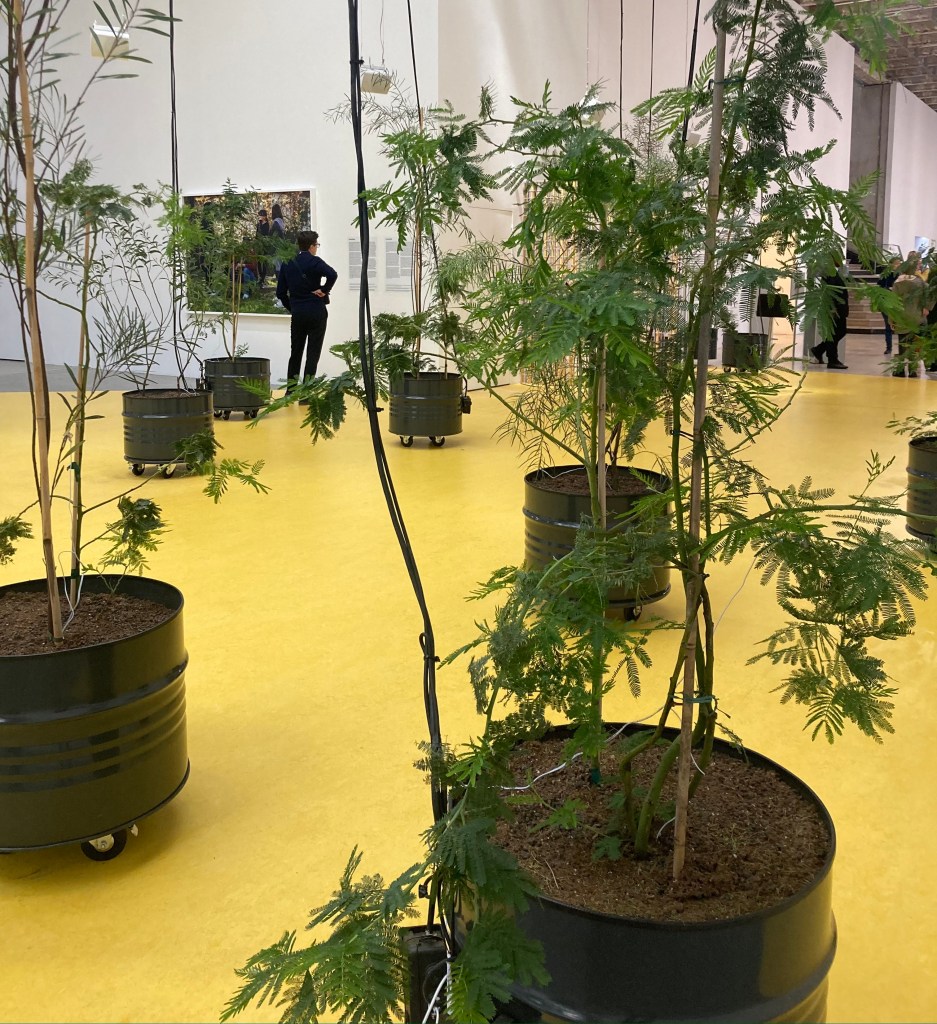
As we go through two grids subtly positioned at each end of the entrance, we are greeted by a lush interior with blooming acacias on pots. The yellow carpet on the floor––part of the artist’s project Brutal Family Roots presented during the Sydney Biennial in 2020––echoes the color of the flower while also signifying treachery. For the artist, acacias are imbued with personal meaning, they are tied with childhood memories representing his own private Ithaca. However, the plant is not autochthonous to Northern Africa, it was brought by colons to the territory from Australia resulting in dismantling the artist’s own mythology. So, a symbol of the region is in fact contaminated by encounter, the story of colonization is not monolithic and the journey of these plants––rendered possible by globalization––unveils the hidden connections between remote geographies. The installation raises the question of what constitutes an identity, is there such a thing as “purity”? When examining concepts like nationhood or exoticism it’s always a matter of perspective.
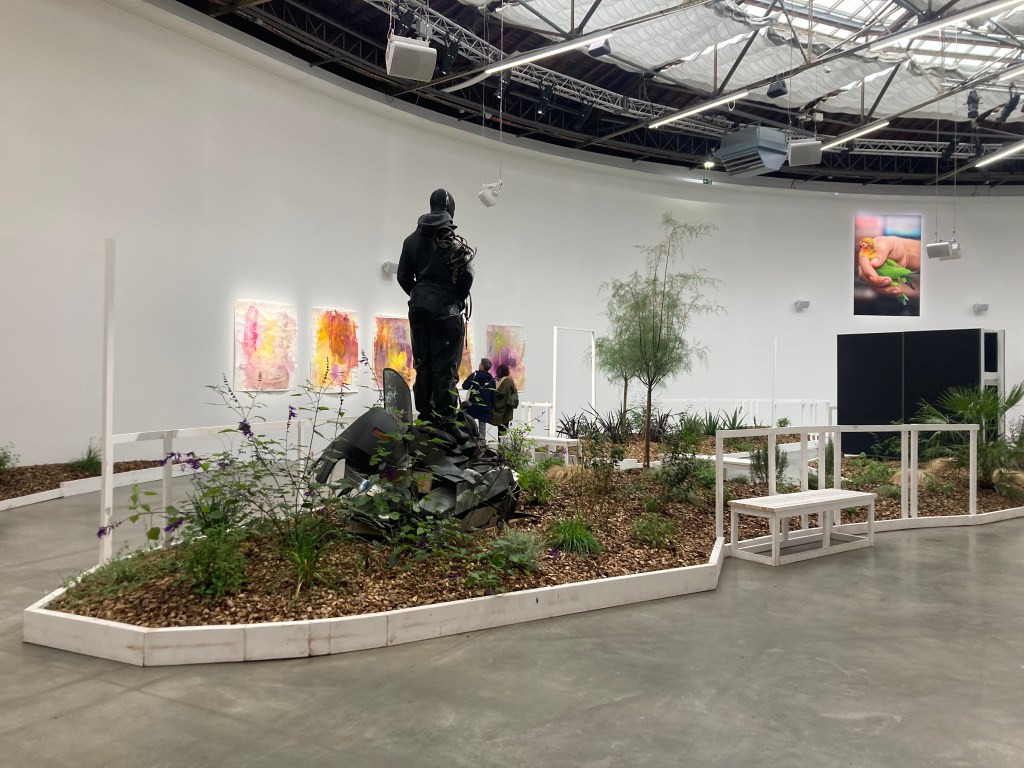
Across the exhibition space Giardini (2024) comprised by a combination of several other artworks such as The whispering of ghosts (2018-2020), confronts the viewer to the hegemonic portrayal of minorities. Whether interviewing a patient from a mental health facility turned into a gardener, interacting with a man reading his prison sentence or photographing the lower part of a body wearing an electronic tag, Bourouissa puts center stage marginalized groups so as to give them back power. Having agency over one’s own image is powerful, with series such as Horse Day (2013-2017) not only he criticizes the invisibilization of entire communities, he also permits these collectives to have their own voice and tell their own stories reversing power relations. An assemblage of this series consisting of 3D sculptures, car parts, horse reins, a video projection among other objects is to be found at the end of the exhibition but it blends with the rest of the works contributing to the harmonization of the entire space. Collectivization for the artist is a step towards restoration and sharing stories of dislocation, of oppression, enables us to become aware of our strength.
Although the specter of figures like Frantz Fanon looms large, the show expands on fellow contributors, regardless if they are “accomplished” artists or amateurs. Following this idea, the room at the end of the exhibition houses the Sahab Museum, an initiative founded by Mohamed Abusal, Sondos El-Nakhala, Salman Nawati and Bourouissa himself aimed at using digital technologies to research and document the stories of Gaza. Mattresses are positioned on the room’s floor encouraging viewers to lay down and contemplate the immersive installation, right in the middle of the room, a giant white tiger is placed next to a screen enabling spectators to choose artworks by Palestinian artists from a catalog to project them on the walls. As we look at the artworks, we are reminded that Gaza and Palestine are much more than a disputed territory, the country is home to living creatures with dreams and aspirations, helping humanize vilified populations.
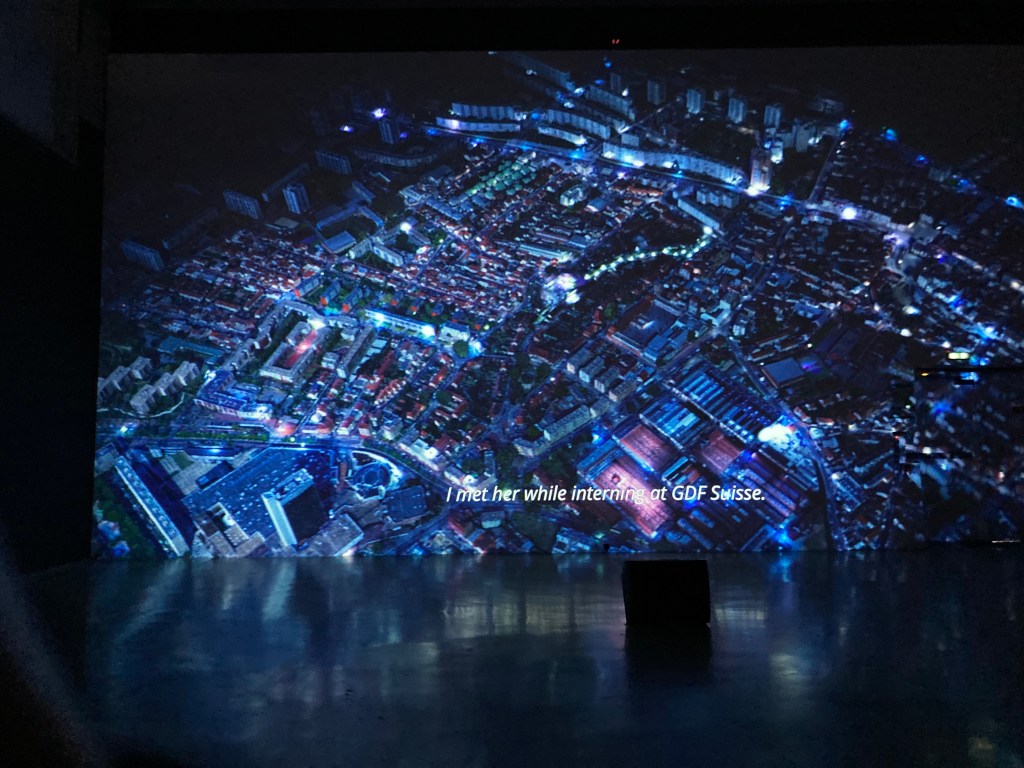
The exhibition feels like a breath of fresh air for its ability to reinvent and question the museum space whilst mutating the artist’s own work. Each piece is a perpetual work in progress, a body part helping build an ever evolving organism. Our senses are constantly being solicited. Through our sight or hearing, Bourouissa urges our body to react, to reenact what his collaborators feel, what he calls the “dispossession of their bodies”. For instance, the film Généalogie de la violence (2024) conceived specifically for the exhibition, narrates the story of a French teenager from Paris’ suburbia. During a stop and search we are taken on a journey into the young man’s bowels, while the character describes his feelings throughout this humiliating intervention, we simultaneously see how fear takes hold of his body. Herein lies the dichotomy of “othered” bodies, at once invisible and policed, “seen and unseen, visible and invisible”, invariably subdued. The series Shoplifters (2014) showed at a corner of the show manifests this contradiction of bodies being both exposed and neglected prompting questions about the representation of people living in the margins of society. Paraphrasing Judith Butler, “there can surely be, and are, different modalities of violence”. Certainly exposing people for stealing basic needs products is a form of violence. When shaming and dispossessing bodies, what is left is an invisible imprint beared forevermore by the subject, Bourouissa gives shape to this feeling through a 3D rendering where two stretched arms plastered on the wall call to mind the position of bodies when pat-downed.
Fear can be an immediate reaction to abusive situations, nevertheless, the artist does all to encourage his viewership to react otherwise. His photograph––presumably a self-portrait––of a man with a tarantula on his neck inspires us to consider what causes distress. All the artworks in the exhibition respond to one another creating a rhythmic constellation, a collective garden containing multitudes and celebrating polyphonic sounds. In a crucial moment where wars decimate entire populations and the far right promises to make its comeback, this exhibition is a beam of hope in a rather somber horizon.
Anna Lowenhaupt Tsing, The mushroom at the end of the world (Princeton and Oxford: Princeton University Press, 2021), 27
Legacy Russell, Glitch Feminism. A manifesto (London and New York: Verso, 2020), 55
Judith Butler, Frames of war. When is life grievable? (London and New York: Verso, 2010), xiii
#mohamedbourouissa #frantzfanon #palaisdetokyo #judithbutler #legacyrussell #annalowenhaupttsing #sahabmuseum
 Yet Another Art Blog